Behavioural Design: Digital Ledger
Context
In 2019, during a 3-month study across Karachi and Lahore, I observed the inefficiencies of paper-based ledgers or “khatas” for small businesses. Manual reconciliation was time-consuming, error-prone and socially awkward when it came to reminding customers—often friends and family—to repay their credit on time. Small business owners spent hours communicating on WhatsApp despite a lack of formal literacy. Inspired by WhatsApp’s simple interface, we envisioned a solution that could seamlessly integrate into the lives of entrepreneurs. My approach:
Applying nudge theory to reduce friction in payment reminders via WhatsApp and SMS
Using participatory methods to design an interface based on simplicity and familiarity
Feedback and iterative testing to refine choice architecture and navigation
Outcomes included a 50% reduction in delayed payments and a 60% improvement in cash flow, showing the role of design in developing trust and engagement.
ROLE
Head of Design and Project Lead
TEAM
Product Designer II
Brand Lead
Head of Engineering
Software Engineer
TIMELINE
3 months, Live in May 2024
Problem
“How might we solve for the inefficiencies and social discomfort that paper-based ledgers create for small businesses, particularly when requesting timely repayments from within their networks.”
Hypothesis
By introducing a free digital ledger with a familiar interface, businesses would experience faster reconciliations and fewer issues with repayment reminders. Automating reminders via text messages could reduce social friction and improve cash flow management for businesses.
Process
We conducted an experiment across 8 weeks with 30 small retailers who used paper ledgers and reported cashflow problems across Karachi and Lahore. Building on the principles of Nudge Theory, we sent reminder text messages out to customers on behalf of the retailers at various time intervals to reduce the social awkwardness of direct personal reminders. We then converted our insights into screens, I borrowed learnings from Nir Eyal’s Hook Model, and tested the product with retailers.
Over 8 weeks, shopkeepers reported an improvement in cash-flows and timely repayments. We observed an organic increase in downloads from other businesses, suggesting the establishment of credibility due to social proof.
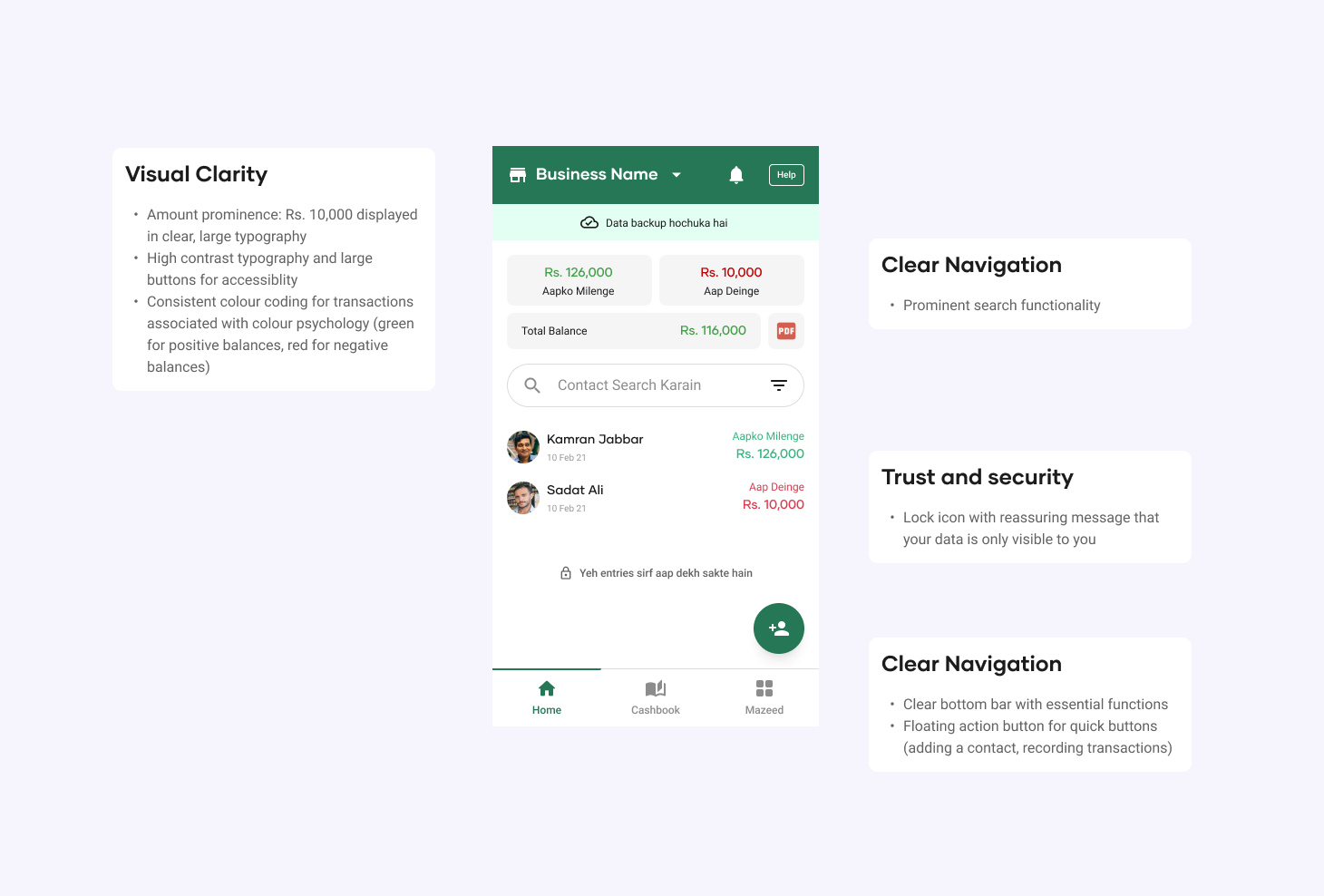
Over 8 weeks, shopkeepers reported an improvement in cash-flows and timely repayments. We observed an organic increase in downloads from other businesses, suggesting the establishment of credibility due to social proof.
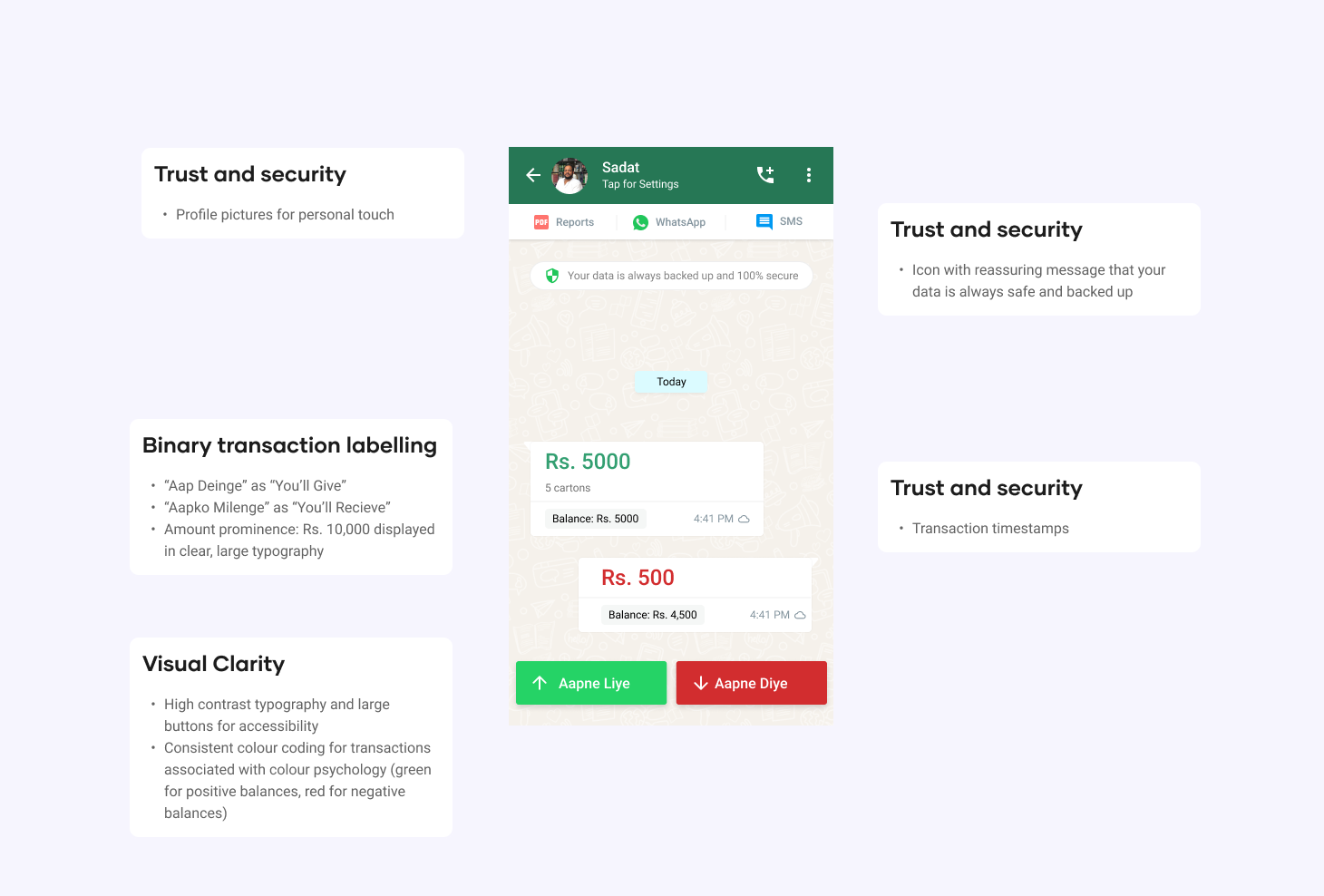
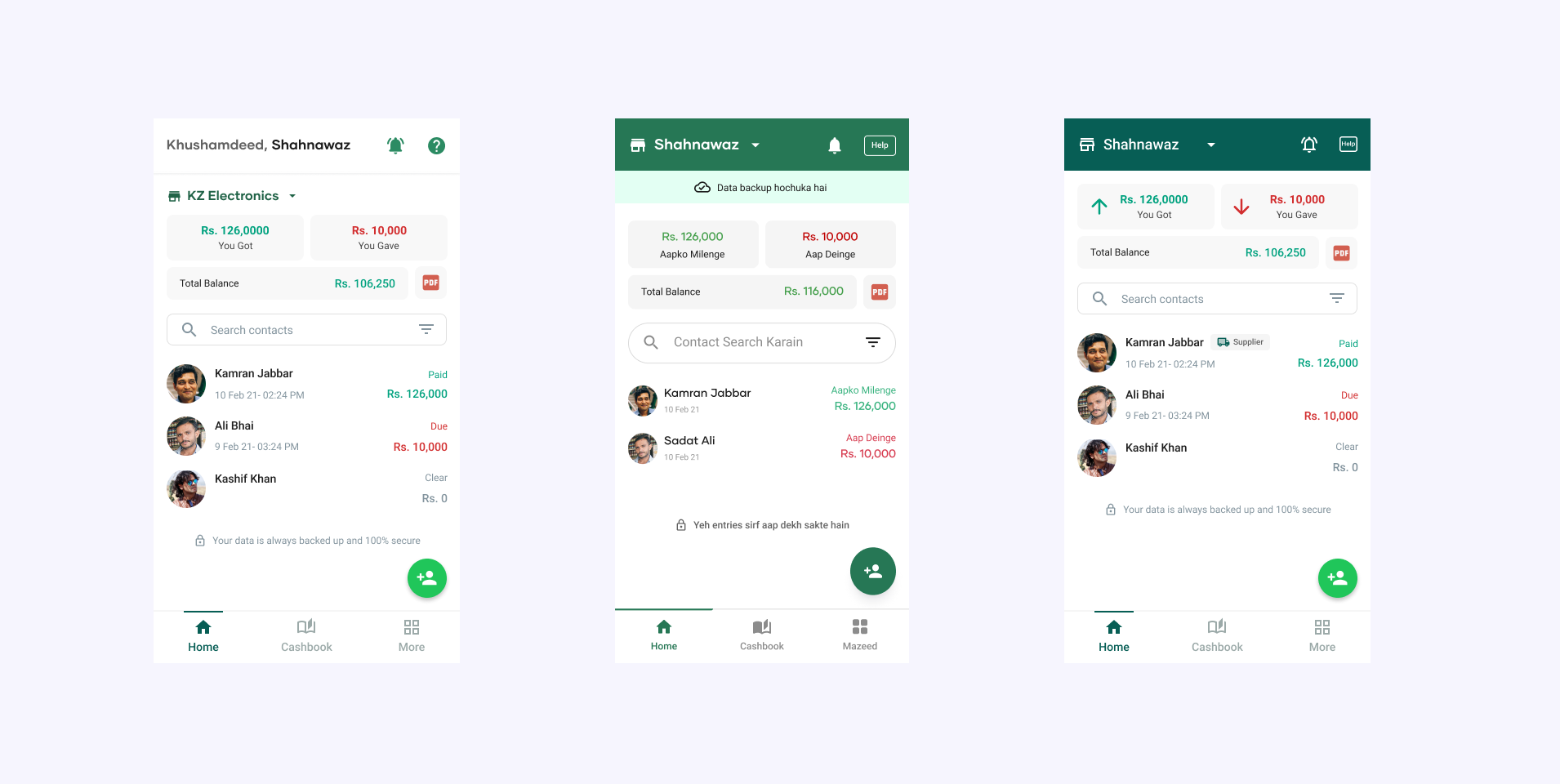
We then launched and tested several iterations of the home screen to assess which was most accessible in terms of choice architecture, familiarity and visual clarity.

Learnings
1. Social Context Matters
Understanding social dynamics is crucial for business design
Digital solutions can help navigate sensitive social situations and create progressive engagement loops
2. Familiarity Breeds Adoption
Using known UI patterns (WhatsApp like) reduced learning friction
Leveraging existing mental models accelerated acceptance
3. Automation of Social Friction
Identifying and automating socially awkward interactions
Creating system driven defaults for difficult social tasks
Over 6 months, cash flow improved by up to 60%, with users reporting a 2x reduction in delayed payments on average.
150,000 Monthly Active Users
92% Net Promoter Score
4M transactions recorded
450 cities and towns